Deterministic AI Validation & Assurance
Validate high-stakes AI-assisted actions before they run.
AxiomGuard evaluates configured actions against deterministic controls, returns a defined disposition, and records traceable decision evidence for review.
AxiomGuard's validation process is organized by a deterministic governance architecture for controls, authority boundaries, disposition precedence, and evidence capture.
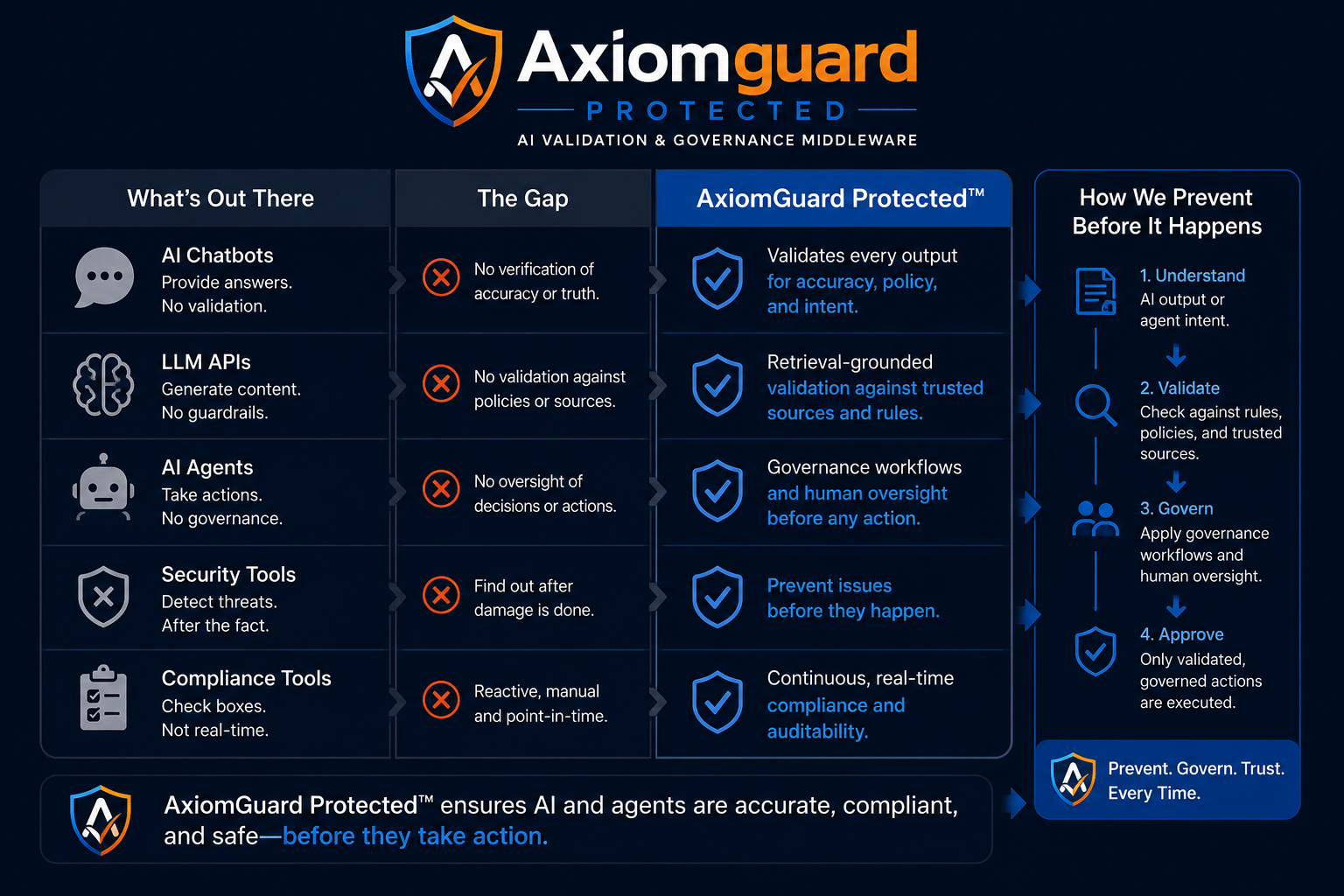


Introducing AxiomGuard Assured™
As organizations deploy AI across business, healthcare, research, government, and critical infrastructure, a recurring question emerges: how do you validate AI-assisted actions before they run?
Rather than replacing AI models, AxiomGuard Assured™ adds a deterministic validation layer between an AI-generated action and its execution — evaluating the proposed action against configured controls and returning a defined disposition.
Architecture
AxiomGuard Assured™ evaluates configured actions at runtime. When an evaluation returns ESCALATE, the built-in GEAE™, a patented internal engine, routes the action into Authorized Exception Review — a policy-bound review path with independent reviewers, quorum requirements where appropriate, and a separate override receipt preserved as decision evidence in QuPin™.
- Rule Extraction
- Semantic Grounding
- Retrieval-Augmented Validation (RAG)
- Formal Verification
- Deterministic Validation
- Allow / Hold / Block / Escalate Dispositions
- Authorized Exception Review
- Quorum Approval & Override Receipt
- Final Operational Outcome Logging
- Traceable Decision Evidence
Resolve Integration Technologies is currently exploring pilot opportunities and research collaborations, including ongoing work with researchers at the University of Utah related to next-generation validation architectures for autonomous AI systems.
The Validation Architecture
How AxiomGuard Validates Proposed Actions
Six stages of deterministic validation, from a submitted action to a defined disposition and recorded decision evidence.
Submit a Proposed Action
AxiomGuard evaluates configured AI-assisted actions before they run. A proposed action — an LLM response, an autonomous command, or a decision-engine output — is submitted to the validation layer and normalized into a structured evaluation input.
Designed to work alongside LLMs, autonomous agents, and multi-model pipelines through configured integrations.
Deterministic Control Evaluation
The proposed action is evaluated against your configured controls — Boolean invariants organized by DOS 2.0™. Evaluation is deterministic: the same input, ruleset, and engine version return the same disposition. For example, when a control specifies a maximum dosage of 100mg and an action proposes 500mg, that action returns a BLOCK disposition rather than proceeding.
Organized by DOS 2.0™ (Deterministic Operating Substrate) — the logic core that makes AxiomGuard’s evaluations replayable against a recorded input and ruleset hash.
Authorized Exception Review
When an evaluation returns ESCALATE, the action enters Authorized Exception Review rather than proceeding automatically. Authorized reviewers assess the escalated action under policy, evidence, independence rules, and quorum requirements where appropriate. The review outcome is separately recorded and receipted as decision evidence in QuPin™.
Routed internally by GEAE™ — a patented engine built into AxiomGuard Assured™. GEAE™ is not offered as a standalone product.
Traceable Decision Evidence
QuPin™ preserves traceable decision evidence. For configured evaluations, QuPin links the resulting disposition to the decision identifier, evaluated input, fired controls and rule roles, ruleset hash, engine version, timestamps, and assurance-event record — so a decision can be reviewed and replayed against what it was evaluated on.
Each record captures the input and ruleset hashes, engine version, and a matching assurance-event record for later review.
Sentinel Post-Deployment Monitoring
Validation does not stop at a single evaluation. AxiomGuard Sentinel monitors live model behavior for drift, anomalous outputs, and control degradation, and surfaces alerts when a model begins behaving outside its configured bounds.
Drift detection tracks output consistency across model versions, prompt changes, and environmental shifts over time.
Decision Documentation & Reporting
Generate documentation, decision summaries, and review reports from recorded decision evidence. Built for teams that need to show how AI-assisted actions were evaluated to reviewers, boards, and procurement — with each entry traceable to its recorded evaluation.
Exportable reports in formats intended for legal, compliance, and executive review workflows.
Why Pre-Execution Validation Matters
The decision to run an action is separate from the ability to run it.
High-stakes AI-assisted actions can be evaluated against configured controls before they run, so that a proposed action returns a defined disposition — and a record of why — rather than executing unchecked. Below are common validation patterns AxiomGuard is configured to evaluate.
Actions that cross a defined limit
A proposed action falls outside a configured numeric, scope, or permission boundary — for example a value above a set threshold, or an operation targeting a resource outside its allowed scope. A boundary control evaluates the action against that limit and returns a defined disposition before the action runs.
Capability that is not the same as authority
An agent is technically able to perform an action but is not authorized to decide it on its own. A separation control evaluates the proposed action against configured authority boundaries and can route it to Authorized Exception Review rather than allowing it to proceed automatically.
Decisions that must be reviewable later
When an action needs to be explained after the fact, the evaluation, disposition, fired controls, ruleset hash, and engine version are recorded as decision evidence — so the decision can be reviewed and replayed against exactly what it was evaluated on.
Isolated Preview Regression
In a 10-scenario isolated Preview regression, AxiomGuard returned the pre-specified result in all scenarios: 2 ALLOW, 1 HOLD, 3 BLOCK, and 4 ESCALATE. Each live result matched its offline prediction, was attributed to the expected existing configured control, and recorded decision evidence including rule roles, input and ruleset hashes, engine version, a v1 ledger record, and a matching v2 assurance event. The test run occurred in an isolated Preview environment and did not modify Production.
These results reflect the stated scenario set, controls, engine version, and isolated Preview environment. They do not establish outcomes for every model, deployment, integration, or operating condition.
In the Governance Landscape
Why pre-execution validation is on more roadmaps
Recent regulatory and standards developments · linked sources
EU AI Act obligations shift, transparency rules stay in force
The Digital Omnibus (Regulation (EU) 2026/1744) postponed high-risk system obligations to December 2027 and August 2028, while transparency and prohibited-practice rules remain in effect — a longer runway to demonstrate how AI-assisted decisions are evaluated.
artificial-intelligence-act.euStandardsNIST extends its AI risk guidance toward critical infrastructure
Alongside the Generative AI Profile (NIST AI 600-1), NIST released a 2026 concept note for a Trustworthy AI in Critical Infrastructure profile — reinforcing recorded, reviewable risk-management practices for AI-enabled operations.
nist.govAgentic AIOWASP publishes 2026 guidance for securing autonomous agents
OWASP's GenAI Security Project released the 2026 Top 10 for LLM Applications and State of Agentic AI Security and Governance — highlighting authority boundaries and action-level controls for agentic systems.
genai.owasp.org
Ambiguous policy produces ambiguous evaluation.
LogicPIN™ compiles policy into deterministic controls at the source.
Rather than interpreting what an AI probably meant, LogicPIN™ compiles human policy directly into Boolean controls — so the same input, ruleset, and engine version return the same disposition.
The Probabilistic-Deterministic Gap
AI models are probabilistic. A validation layer that evaluates a proposed action deterministically returns the same disposition for the same input. See the difference.
Without AxiomGuard
- Proposed actions run before they are evaluated
- No recorded evidence of why a decision was made
- The same input can produce different outcomes
- Boundary violations are noticed after the fact
- An escalation ends with no recorded review path
- No separation between the original decision and a later override
- Drift is noticed only once behavior has changed
With AxiomGuard
- A proposed action is evaluated before it runs
- Each configured evaluation records decision evidence
- The same input, ruleset, and engine version return the same disposition
- Actions outside a configured boundary return a defined disposition
- ESCALATE routes into Authorized Exception Review
- Original decision, exception review, and outcome are separately receipted
- Sentinel monitors for drift after deployment
Why AxiomGuard?
Deterministic validation between a proposed AI-assisted action and its execution. Evaluate, return a disposition, record the evidence.
Runtime Validation
Evaluate a proposed AI-assisted action against configured controls before it runs. Deterministic evaluation returns a defined disposition rather than a probability score.
Traceable Decision Evidence
Each configured evaluation is recorded with its input and ruleset hashes, fired controls, engine version, and a matching assurance event — so a decision can be reviewed and replayed.
Sentinel Post-Deployment Monitoring
Continuous monitoring, drift detection, and anomaly alerts after deployment. Sentinel surfaces when a model begins behaving outside its configured bounds.
Configurable Validation Patterns
Where AxiomGuard Validates
Each pattern below describes how controls can be configured to evaluate a proposed action and return a defined disposition. Examples are illustrative and depend on the controls configured for a given deployment.
Clinical Boundary Controls
Configure controls for dosage limits, triage bounds, and protocol constraints. A proposed action outside a configured boundary is evaluated deterministically and returns a defined disposition before it reaches downstream systems.
Example: A proposed order specifies a value above a configured dosage limit — the evaluation returns a BLOCK disposition and records the fired control.
Citation & Source Validation
Configure controls that require generated legal content to reference verified sources. Proposed filings can be evaluated against those controls and returned for review before submission.
Example: A proposed brief references sources outside the verified set — the evaluation returns an ESCALATE disposition for Authorized Exception Review.
Trading Boundary Controls
Configure position limits, risk thresholds, and output constraints. Proposed actions are evaluated against those controls, and each evaluation records decision evidence for later review.
Example: A proposed trade exceeds a configured risk threshold — the evaluation returns a BLOCK disposition and records a matching assurance event.
Reviewable Decision Evidence
Configure evaluations so that each disposition is recorded with its input and ruleset hashes, fired controls, and engine version — supporting internal review processes that call for replayable records.
Example: A reviewer requests the basis for a decision — QuPin™ returns the recorded evaluation, fired controls, and hashes for that decision identifier.
Operational Command Controls
Configure controls for high-impact operational commands so a proposed command is evaluated against authority and boundary constraints before it proceeds.
Example: A proposed command targets a resource outside its configured scope — the evaluation returns a BLOCK disposition and records the fired control.
Agent Action Controls
Configure controls for agent and assistant actions so a proposed action is evaluated against policy and authority boundaries, and routed to Authorized Exception Review where configured.
Example: A customer-facing agent proposes an action outside its configured policy — the evaluation returns an ESCALATE disposition and routes it for review.
Validation in Action
Live Demos
Working prototypes across high-stakes domains — each one running AxiomGuard deterministic validation logic. Behavior in each demo reflects the controls configured for that demo.
These demos run the same DOS 2.0™ deterministic evaluation used in a configured deployment.
AI Validation Platform Demo
The full AxiomGuard validation platform in action -- live scenarios showing deterministic control evaluation, disposition precedence, Authorized Exception Review routing, and QuPin™ decision evidence.
Robotics Safety
See how a proposed autonomous robot command is evaluated against configured motion and boundary controls and returns a defined disposition before it executes.
Grid Safety Dashboard
See how a proposed grid action is evaluated against configured capacity and scope controls and returns a defined disposition before it proceeds.
Finance Trading Engine
See how a proposed trade is evaluated against configured position and risk-threshold controls and returns a defined disposition before execution.
Safety Integrity Dashboard
A unified view of validation metrics, drift detection, and decision-evidence status across connected systems.
Academic Prompt Testing
Evaluate AI prompts against deterministic controls in a research-grade environment -- with replayable results for reproducible studies.
Legal AI Citation Validator
Paste an AI-generated legal brief and see how a configured citation control evaluates each reference against a verified source set and returns a defined disposition.
RAG Middleware Demo
See deterministic control selection and evaluation in action. Choose a workflow, ambiguity level, and risk tier, then watch the evaluation return a defined disposition.
Insurance Claims Validator
See how configured controls evaluate a proposed claims decision against eligibility and policy constraints and return a defined disposition before it is applied.
LogicPIN™ Governance Demo
See LogicPIN™ in action: natural language policy intake compiled into deterministic controls, checkpoint evaluation, and QuPin™ decision evidence. Human intent becomes deterministic controls.
Ready to evaluate AxiomGuard deterministic validation in your environment?
Contact UsPlatform Architecture
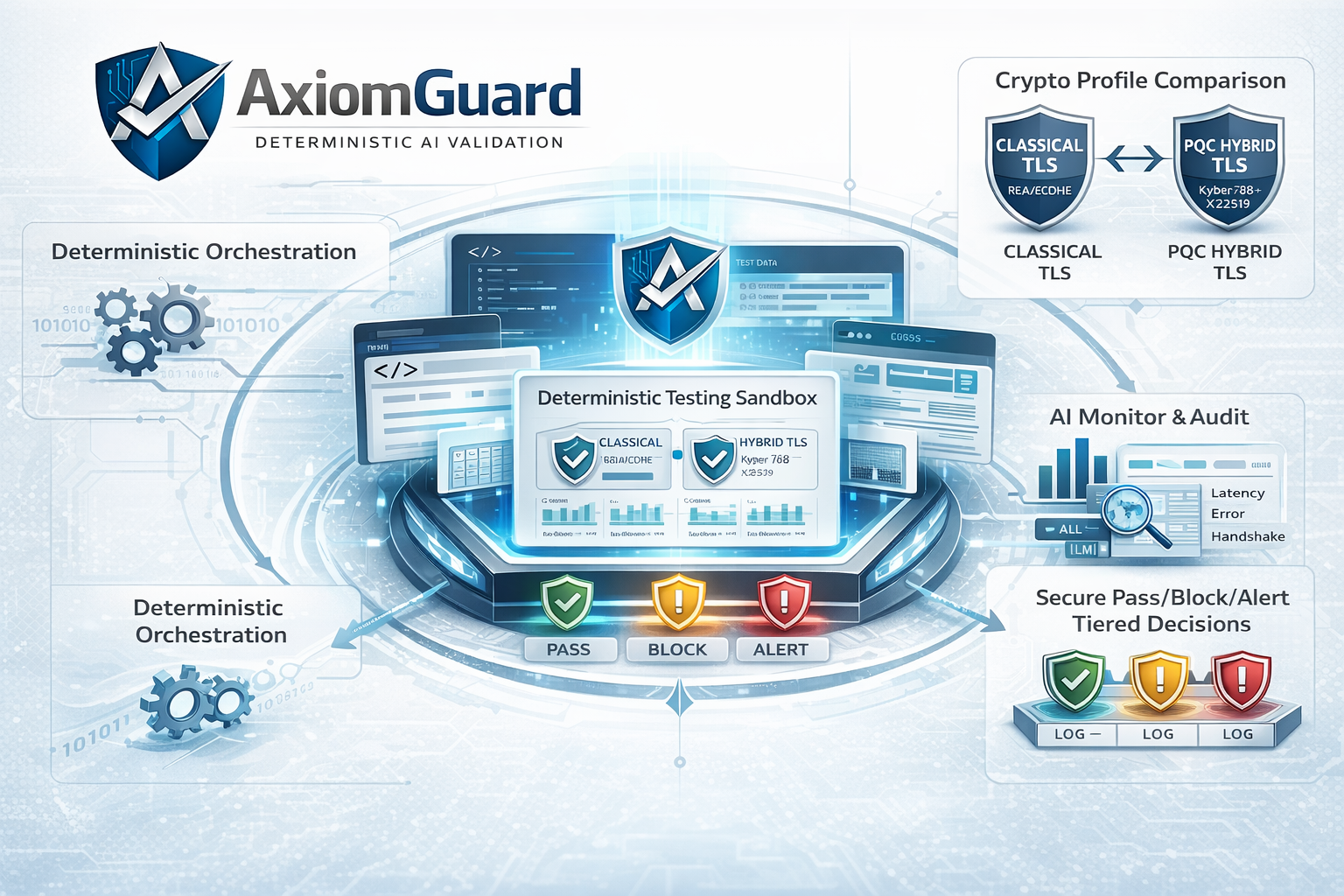
A deterministic validation pipeline -- from orchestration and profile comparison to runtime monitoring, control evaluation, and tiered allow / hold / block / escalate dispositions.
Proprietary Technology
The Technology Stack
AxiomGuard is built on two proprietary engines — a deterministic control substrate and a decision evidence layer — designed for replayable evaluation and reviewable decisions.
DOS 2.0™
Deterministic Operating Substrate
The logic core of AxiomGuard. DOS 2.0™ evaluates a proposed action against configured Boolean controls and returns a defined disposition. The same input, ruleset, and engine version return the same result — deterministic and replayable.
QuPin™
Decision Evidence Layer — Organized by DOS 2.0™
QuPin™ preserves traceable decision evidence. For configured evaluations, it links the resulting disposition to the decision identifier, evaluated input, fired controls and rule roles, ruleset hash, engine version, timestamps, and assurance-event record.
Neural · Symbolic · Hybrid
Neural Tech Is a Sensor. Never the Authority.
AxiomGuard provides deterministic runtime validation around neural, symbolic, and hybrid neuro-symbolic AI systems. Neural anomaly detectors and hallucination taggers act as optional sensors feeding the evaluation — while deterministic logic returns the final, replayable disposition.
Optional Input
Stage 1 of 3
Neural Models as Sensors
Anomaly detectors, drift and hallucination taggers, and pattern classifiers watch logs, traces, and agent behavior. They emit scores and tags — “92% suspicious” — and nothing more.
- Anomaly detection
- Hallucination tagging
- Drift scoring
- Behavior classification
Validation Core
Stage 2 of 3
Deterministic Evaluation
Neural signals become inputs — combined with LogicPin™ controls, system state, and deterministic constraints to reach a defined disposition such as ALLOW, HOLD, BLOCK, or ESCALATE. Every path is replayable.
- LogicPin™ rules
- DOS 2.0™ substrate
- System state
- Replayable traces
Final Authority
Stage 3 of 3
The Deterministic Gate Decides
Deterministic logic returns the final, replayable disposition and QuPin™ records it as decision evidence. A probabilistic signal is an input to the evaluation, not the decision-maker.
- Deterministic constraints
- Replayable outcome
- QuPin™ evidence
- Recorded decision
The neural pieces never become the decision-maker.
Plug in whatever model you want — LLMs, symbolic engines, or hybrid neuro-symbolic systems. AxiomGuard stays deterministic underneath all of it, so the evaluation layer does not inherit the uncertainty of the thing it evaluates.
Powered by AxiomGuard
Introducing LogicPIN™
The natural language policy engine inside AxiomGuard. LogicPIN™ translates human intent into deterministic controls — not probabilistic interpretation.
Product of Resolve Integration Technologies LLC
“ ...human intent is translated into enforceable logic rather than probabilistic interpretation. ”
Natural Language Input
Human policy written in plain language is ingested and understood — no code required.
Deterministic Validation
Policy is compiled into Boolean controls that return the same disposition for the same input.
Defined Dispositions
A proposed action is evaluated against those controls and returns a defined disposition before it runs.
Traceable Decisions
Each configured evaluation is recorded as decision evidence via QuPin™ for later review.
Where LogicPIN™ fits in your stack
The AxiomGuard Ecosystem
One validation platform. Four integrated components.
AxiomGuard
Deterministic AI Validation Platform
AxiomGuard Assured™
Deterministic AI Validation & Assurance
LogicPIN™
Deterministic Validation Middleware

AxiomSentinel
Post-Deployment Monitoring & Drift Detection
Powered by DOS 2.0™
Frequently Asked Questions
Everything you need to know about AxiomGuard, DOS 2.0\u2122, QuPin\u2122, and deterministic AI validation.
Now Onboarding Pilot Partners
Be among the first to evaluate deterministic AI validation and assurance in your environment.
Pilot Partner
Free access during preview. Direct engineering support. Input on roadmap.
Enterprise
Custom pricing. SLA. Full validation platform. Dedicated onboarding.
Email directly: danreosolvesystems@gmail.com